
The house tour checklist: what to actually look at
Updated July 5, 2026
On a house tour, spend your attention on what you can't change (light, layout, noise, and how the home sits on its street) and what costs real money to fix (roof, windows, HVAC, water). Paint, staging, and hardware are decoration. Bones and location are the house.
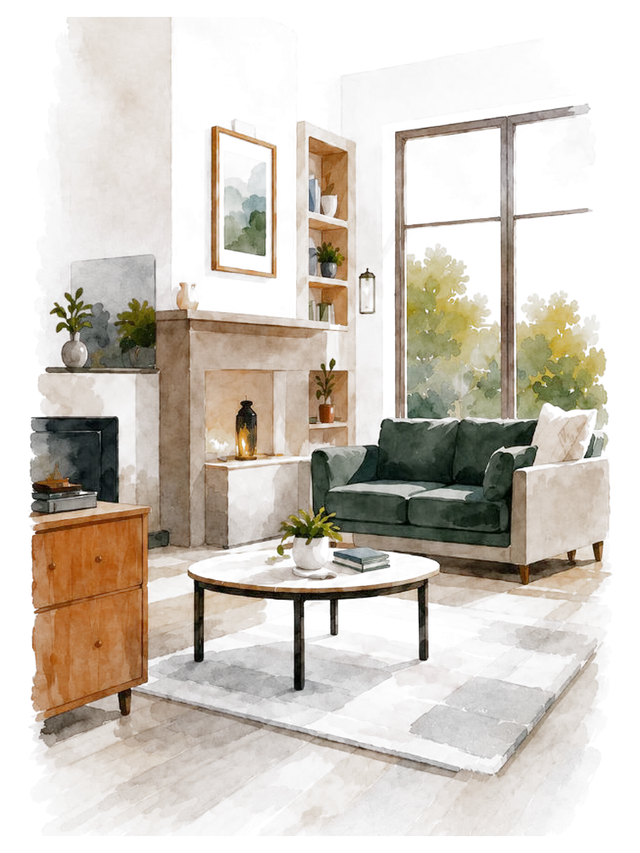
Every house tour gives you a fixed budget of attention, and the staging is designed to spend it for you. Warm cookies, soft throws, tasteful art. All of it leaves with the sellers. This home tour checklist is about spending your attention on what stays.
Start outside, before you ring the bell
Arrive ten minutes early and use them.
- Walk the street. Are cars parked everywhere, or is it quiet? Do the neighbors keep their places up? You’re buying into this block as much as this house.
- Look up at the roofline. Sagging lines, curling shingles, or moss can mean a roof bill in your first few years. Ask the age; most roofs live 20 to 30 years.
- Look down at the ground. The soil should slope away from the foundation. Puddles near the house, downspouts dumping at the wall, or a yard that drains toward the back door are how basements get wet.
- Check the driveway and walkways. Big cracks and heaving concrete are fixable but not cheap, and they hint at how the ground moves.
The things you can’t change
Inside, give your first full lap to the stuff no renovation can touch.
- Light. Which way do the main rooms face? South-facing living space gets sun most of the day; north-facing rooms stay dim in winter. Tour in daylight if you can, and notice where the light actually lands at the hour you’d be home.
- Layout. Walk your real life: door to kitchen with imaginary groceries, bedroom to bathroom at night, front door to wherever the noise and shoes would pile up. A beautiful kitchen in the wrong place stays in the wrong place.
- Ceiling heights and sight lines. Low ceilings and choppy sight lines make square footage feel smaller than the listing number.
- Noise. Stop talking for thirty seconds in the main bedroom and the backyard. Highway hum, flight paths, the neighbor’s dog. Sellers can’t turn those off, and neither can you.
- How the home sits. A great house shoulder-to-shoulder with a gas station is still shoulder-to-shoulder with a gas station.
The things that cost real money
None of these should necessarily kill a deal, but every one belongs in your notes and your budget math.
- Roof age (ask, then verify in the inspection).
- Windows. Single-pane or fogged double-pane windows across a whole house is a five-figure line item.
- HVAC. Find the unit and look for a manufacture date; 15 years or older means you’re shopping for its replacement.
- Water heater. Same move; they last about 10 to 12 years.
- Electrical panel. Snap a photo. An inspector can tell you if the brand or capacity is a problem.
- Water, everywhere it shouldn’t be. Ceiling stains, soft spots under sinks, musty basement air, a dehumidifier already running, fresh paint on a single patch. Water damage is the most expensive thing to discover late.
The daily-life details
These decide whether the house works on a wet Tuesday in February.
- Storage. Count the closets. Where do coats, vacuums, suitcases, and holiday boxes live?
- Kitchen triangle. Stand at the stove: can you reach sink and fridge without a hike? Is there counter space next to the stove and fridge where you actually need it?
- Bathrooms. Enough for your household on a school morning? Water pressure is a ten-second test; run the shower.
- Laundry. Where is it, and what does the trip with a full basket look like?
- Parking and arrival. Where do you park in the rain? Where do groceries come in?
- Phone signal. Check your bars in the kitchen and the bedroom. Seriously.
What to ignore
Paint colors, cabinet hardware, light fixtures, staging furniture, landscaping accessories, and any smell of baking. These are the cheapest things to change and the most engineered part of your first impression. If you catch yourself falling for a house because of a throw pillow, walk your lap again.
Split the jobs
Touring as a couple? Don’t shadow each other. One of you walks the feel: light, flow, “could our life happen here.” The other runs the money list: roof, water, mechanicals, windows. Halfway through, swap. You’ll each see the house twice through different eyes, and your notes will disagree in the useful ways.
Capture it or lose it
Whatever system you use, use it in the moment. By tonight, this house will be blending into the last one, and by Saturday it’ll be gone. Photos of the same five things at every house, a voice note in the car before you pull away, and one honest first impression while you can still smell the place. Future you, sitting across from your partner trying to decide, will be grateful.
Quick answers
- How long should a house tour take?
- For a home you're serious about, plan 30 to 45 minutes. Under 15 minutes usually means you toured the staging, not the house. If the schedule only allows a quick pass, focus on layout, light, and water signs, and request a second showing before offering.
- What should I check first on a house tour?
- Start outside. The roofline, the grading, the street, and the neighbors' homes tell you things no interior can hide. Then walk the layout before you look at any finishes.
- What are the biggest red flags on a home tour?
- Water is the big one: stains on ceilings or basement walls, musty smells, fresh paint on one patch of ceiling, and ground that slopes toward the house. After water, look for foundation cracks wider than a pencil, an aging roof, and windows or HVAC near end of life.
- Should both partners look at the same things?
- No, split the jobs. One of you walks the feel of the house while the other checks the mechanical stuff, then swap for ten minutes. You'll cover twice as much and compare notes on the drive home.